
Welcome to the world of effects! If you’ve just picked up an electric guitar, you’re probably wondering which stompboxes will help shape your sound. The truth is, the landscape of hundreds of colorful boxes can feel overwhelming at first.
Many players start their journey with confusion. One guitarist recalls beginning with a DOD Grunge overdrive and Dunlop Cry Baby wah. The sounds didn’t quite work together, and it took time to understand why.
Not immediately! Great guitar tone starts with YOUR FINGERS, your instrument, and your amplifier. Pedals enhance – not replace – solid playing. However, 4 essential pedals form the foundation most guitarists build upon: Tuner (keeps you in pitch), Overdrive (warmth + dynamics), Distortion (heavier crunch), and Delay (echoes + space). Start with 3-5 pedals maximum, expand thoughtfully as your musical needs grow!
- DON’T chase hype! That $300 boutique Klon clone won’t make you play better. A $50 pedal that serves YOUR music beats expensive gear that sits unused.
- Learn your amp FIRST! Many beginners buy pedals for tones already available through proper amp settings. Master Volume, Gain, and Tone knobs before shopping.
- Effects serve YOUR music! Blues needs minimal gear (overdrive + delay). Metal needs gain-stacking. Ambient needs layers. Let YOUR STYLE guide purchases.
- Start small, expand smart! 3-5 pedals maximum initially. Master each effect individually BEFORE adding complexity. Quality beats quantity always.
- 1 Master your guitar + amp first. Explore what sounds you can create with just volume/tone knobs + amp settings.
- 2 Identify specific sounds you NEED. What tones can’t you achieve with current gear? That tells you what pedal to buy next.
- 3 Start with The Essential 4. Tuner (always) + Overdrive/Distortion (your style) + Delay (versatile). Budget: $150-300 total.
- 4 Test with YOUR gear! Pedals sound different through different amps. Test before buying. Consider used pedals (50% savings!).
- 5 Expand thoughtfully, never impulsively. Avoid GAS (Gear Acquisition Syndrome). Add pedals when genuine musical needs arise.
Here’s the key insight: effects should serve your musical expression, not just follow trends or influencer recommendations. Your pedalboard shouldn’t be built on hype or expensive boutique gear alone. Instead, focus on essential guitar pedals that enhance your natural playing style.
Before investing heavily, learn your amp’s capabilities. Whether you’re switching from a digital amp like the Boss Katana to a tube amp or just starting out, remember this: great guitar tone starts with your fingers, your instrument, and your amplifier. Pedals are tools to enhance, not replace, solid guitar playing.
This guide offers a practical, no-nonsense approach drawn from real guitarist experiences. We’ll help you build your guitar tone foundation without breaking the bank.
Introduction: Do You Really Need Guitar Pedals as a Beginner?
If you’re a beginner guitarist, you’ve probably noticed countless players with impressive pedalboards and wondered if you need the same setup. The truth is, guitar pedals can be incredible tools, but they’re not required the moment you pick up your first guitar. Understanding when and why to add effects to your rig will save you money and help you develop as a musician.
Before you start shopping for pedals, it’s worth exploring what your amp and guitar can already do. Many experienced players advise beginners to learn what sounds you can create with just these two pieces of equipment. Your guitar’s volume and tone knobs, combined with your amp’s gain and EQ settings, offer more tonal variety than you might expect.
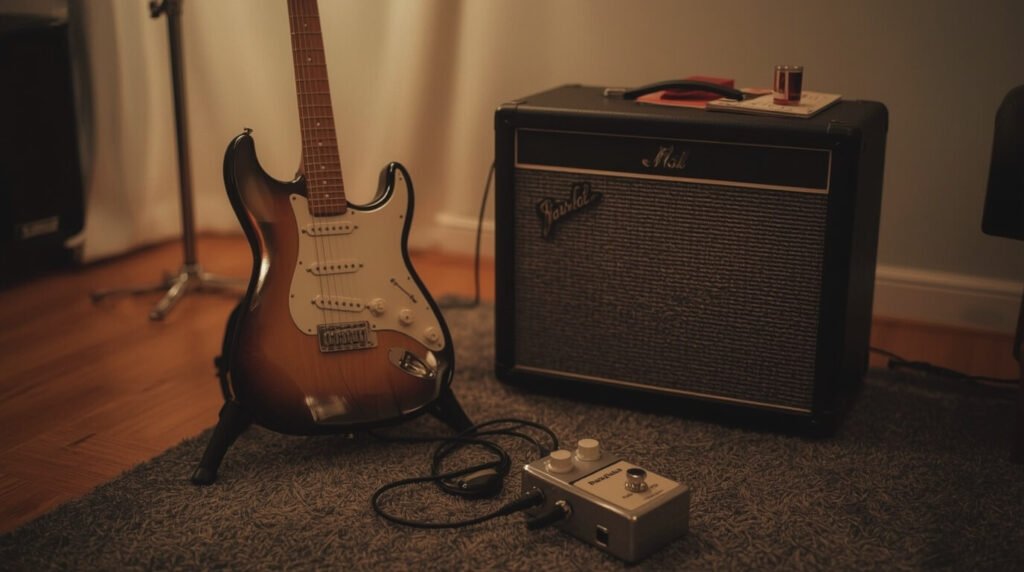
Understanding Guitar Effects and How They Shape Your Tone
A guitar effect is any device that modifies the signal traveling from your guitar to your amplifier. These modifications alter your guitar sound in specific ways, opening up new sonic possibilities. Some effects add warmth and grit, while others create space and atmosphere.
Different types of effects serve different purposes. Gain-based pedals make your guitar sound more aggressive or saturated. Time-based effects like delay add echoes that create depth. Modulation effects change the texture and movement of your tone.
Understanding how guitar effects work helps you make informed decisions rather than impulse purchases. You’ll know exactly what each pedal does and whether it fits your musical vision. This knowledge becomes your foundation for building a pedalboard that actually enhances your playing.
Why Beginners Benefit from Essential Guitar Pedals
While your first guitar and amp form your tonal foundation, certain effects simply can’t be replicated by adjusting knobs. Delay, chorus, and wah are examples of sounds that require dedicated pedals. These effects help you explore different musical styles and discover what inspires you.
One seasoned guitar player puts it this way: “You can get a lot out of a tube amp just by adjusting the Volume, Gain and Tone on the amp and guitar.” This advice is valuable because many beginners chase sounds by buying pedals when the tone they want is already available through proper technique and settings.
However, having a few essential pedals allows you to make your guitar fit different songs and genres. A good overdrive pedal gives you tonal options your amp might not offer. A tuner pedal keeps you in pitch during practice and performances. These tools support your growth as a guitar player without overwhelming you.
The key is balance. Start by mastering your instrument and understanding your amplifier’s capabilities. Then add pedals strategically as you identify specific sounds you need. This approach ensures every pedal on your board serves a real purpose in your music.
How Guitar Pedals Work
Learning how guitar pedals process your sound opens up a world of creative possibilities for your playing. These small devices are essential tools that give you control over your tone. Understanding the basics helps you make smarter choices when building your setup.
The technology isn’t complicated once you break it down. Your guitar pedal takes the signal from your instrument and modifies it before sending it to your amp. This simple process creates everything from subtle warmth to dramatic effects.
The Basics of Guitar Effects Pedals
A guitar effects pedal is a compact device that sits on the floor between your guitar and amplifier. It processes your guitar signal to change the sound in specific ways. Each effect pedal is designed to create a particular sonic character.
Most pedals share common physical features. You’ll find an input jack where your guitar cable connects and an output jack that sends the signal forward. A footswitch lets you turn the effect on or off during performance.
The control knobs on top adjust different parameters of the effect. These might control volume, tone, or effect intensity. A power supply connection provides electricity to run the circuitry inside.
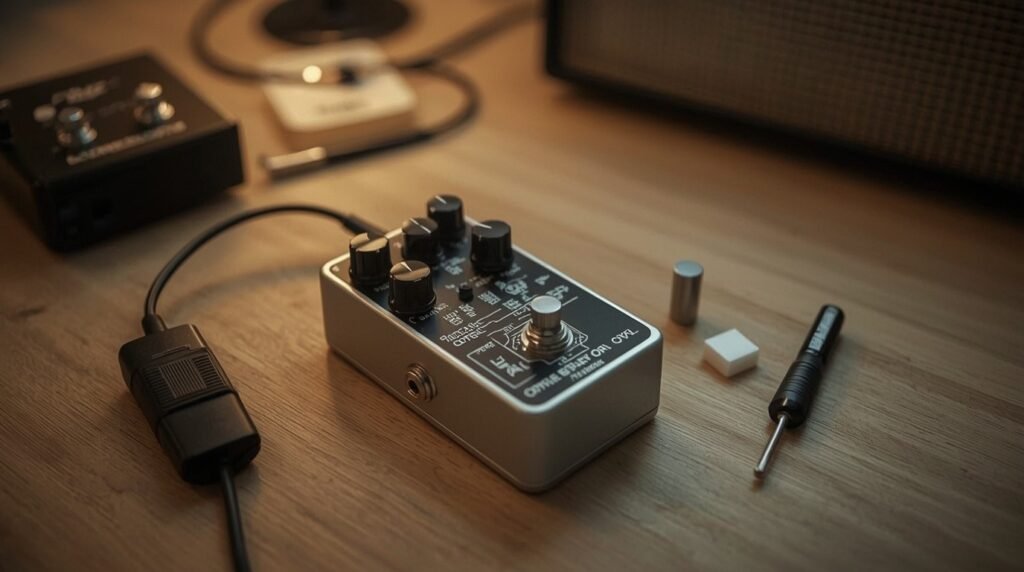
Inside the enclosure, you’ll find either analog or digital circuitry. Analog pedals use traditional electronic components to shape your tone. Digital pedals use computer processing to model effects. Both types can sound excellent, and your choice depends on personal preference.
Understanding Signal Chain and Amp Interaction
The signal chain is the path your guitar signal travels from your instrument to your amplifier. This journey determines how your final tone is shaped. Each guitar pedal in the chain processes the signal and passes it to the next device.
Here’s how it works in practice:
- Your guitar’s pickups generate an electrical signal
- This signal travels through a cable to your first pedal
- Each pedal modifies the signal and sends it forward via patch cables
- The final pedal outputs the processed signal to your amp
The order matters significantly because each pedal affects the already-modified signal from the previous device. A distortion pedal followed by delay sounds different than delay followed by distortion. The signal chain order changes your overall tone dramatically.
Some guitar pedals include buffers that maintain signal strength. Buffers prevent tone loss when you use long cable runs or multiple pedals. They keep your guitar signal strong and clear throughout the entire chain.
Many amps feature effects loops that change how pedals interact with your amplifier. An effects loop places certain pedals after the preamp section. This setup works especially well for time-based effects like delay and reverb.
A good starting guideline for signal chain order is:
- Tuner pedal at the beginning
- Filter effects like wah pedals
- Preamp, overdrive, and boost pedals
- Distortion and fuzz effects
- Modulation effects like chorus
- Delay and reverb at the end
Simple Categories of Pedal Effects
Understanding the different type of pedal categories helps you navigate the world of effects. Each category serves a distinct musical purpose. This framework makes choosing your first guitar pedals much easier.
Gain-based effects add grit, distortion, or overdrive to your sound. These pedals include overdrive, distortion, and fuzz. They’re perfect for rock, blues, and metal styles that need aggressive tones.
Modulation effects create movement and texture in your sound. Chorus pedals thicken your tone by duplicating and slightly detuning your signal. Flanger and phaser pedals add swirling, sweeping textures that sound lush and dynamic.
Time-based effects add space and dimension to your playing. Delay pedals create echoes that repeat your notes. Reverb simulates the natural ambience of different spaces, from small rooms to large halls.
Filter effects emphasize certain frequencies while reducing others. Wah pedals sweep through frequency ranges to create expressive vocal-like sounds. EQ pedals let you boost or cut specific frequency bands for tone shaping.
Dynamic effects control volume levels and sustain. Compressor pedals even out your playing dynamics for a more consistent tone. Volume pedals give you hands-free control over your output level during performance.
Each guitar effects pedal category offers unique creative options. Many guitarists combine multiple types to build complex, layered sounds. Starting with one or two categories helps you learn what each type of pedal contributes to your overall tone.
The First Guitar Pedals Every Beginner Should Have

While the world of guitar pedals can seem endless, a handful of core effects will give you everything you need to start shaping your signature sound. These essential guitar pedals every guitarist should own will serve you reliably whether you’re practicing at home or performing on stage. You don’t need a massive pedalboard to get professional tones.
The four must-have guitar pedals covered in this section form the foundation that most players build upon. Each serves a distinct purpose that you’ll use constantly throughout your playing journey.
The Foundation of Your Setup
Before you dive into creative effects, you need one practical tool that keeps everything in tune. A dedicated tuner pedal might not sound exciting, but it’s absolutely essential for any serious guitarist.
Unlike clip-on tuners, a pedal tuner mutes your signal when engaged. This means your audience won’t hear you adjusting your strings between songs. The display is also much larger and easier to see on dark stages or in bright sunlight.
The Korg PitchBlack X offers a bright, easy-to-read display with 4 display modes modes and High Visibility Display. You can switch between different tuning visualizations depending on your preference.
For legendary durability, the Boss TU-3 remains the gold standard. It’s rugged, accurate, and will last you a lifetime. Many professional guitarists still use the same TU-3 they bought decades ago.
If you’re tight on pedalboard space, consider the Ernie Ball VPJR/Tuner. This clever design combines volume control with tuning functionality, giving you two essential tools in one compact enclosure.

The legendary Boss TU-3 chromatic tuner pedal bundle with premium accessories. Industry-standard tuning precision with ultra-bright LED display, perfect for stage and studio use.
View on Amazon
Korg Pitchblack X with ultra-high precision tuning and large, easy-to-read display. Features true bypass and supports various tuning modes for all guitar styles.
View on Amazon
Ernie Ball VP JR volume pedal in sleek black finish. Compact design with smooth action and durable construction, essential for dynamic control in your guitar rig.
View on AmazonWarmth and Dynamic Response
An overdrive pedal is often the first sound-shaping effect guitarists buy. It adds warmth, grit, and touch sensitivity that responds beautifully to your playing intensity.
When you pick softly, an overdrive keeps your tone relatively clean. Dig in harder with your pick, and you’ll get satisfying grit and sustain. This dynamic response makes overdrive pedals feel natural and expressive.
You can use an overdrive pedal to push a tube amp into natural saturation. Alternatively, it can provide its own character even at lower amp volumes, which is perfect for bedroom practice.
The Boss SD-1 Super Overdrive delivers a classic, extra crispy tone that works beautifully for rock and blues. It’s affordable and has been a staple on pedalboards for generations.
For a more authentic and versatile option, the Ibanez TS9 Tube Screamer delivers the classic mid-boosted overdrive that has shaped countless guitar tones. With responsive gain, smooth clipping, and intuitive controls, it’s a reliable go-to pedal for everything from blues warmth to rock crunch.
If you’re after Klon-style tones without spending a fortune, the J. Rocketts Audio Designs Tour Series Archer IKON offers transparent boost and overdrive for players living in reality budget-wise. It maintains your guitar’s natural character while adding beautiful harmonic richness.

The iconic BOSS SD-1 Super Overdrive delivers warm, smooth overdrive tones. A legendary pedal that has shaped rock and blues sounds for decades with its classic voicing.
View on Amazon
The legendary Ibanez TS9 Tube Screamer, the most famous overdrive pedal in history. Delivers the signature mid-range boost and smooth sustain loved by countless guitarists.
View on Amazon
Premium J. Rockett Archer IKON overdrive and boost pedal. Features refined circuitry for transparent overdrive tones with exceptional clarity and dynamic response.
View on AmazonHeavier Crunch for Rock
A distortion pedal takes things further than overdrive by delivering more aggressive, compressed, and sustained gain. This makes it perfect for heavier rock, punk, and metal styles.
Where overdrive responds dynamically to your playing, distortion provides consistent, thick saturation regardless of how hard you pick. It creates powerful rhythm tones and singing lead sounds with endless sustain.
The ProCo RAT stands as one of the most beloved distortion pedals of all time. Its filter knob sweeps from cutting, aggressive tones that slice through any mix to wild, loud sonic mayhem.
For vintage fuzz pedal sounds inspired by the 1960s, the Boss FZ-5 delivers classic tones at an incredibly affordable price. Fuzz creates an even more aggressive, broken-speaker quality than standard distortion.
The Green Russian Big Muff delivers the legendary, oversized fuzz tones that defined an era. Known for its massive wall-of-sound character, it offers thick saturation, strong low-end punch, and surprisingly clear note definition for such an aggressive circuit.

The legendary Pro Co RAT2 distortion pedal delivers aggressive, cutting tones. A staple of rock and metal with its iconic gritty sound and versatile gain range.
View on Amazon
BOSS FZ-5 fuzz pedal recreates classic fuzz tones from the 60s and 70s. Features vintage fuzz voicings with modern reliability and controllability for any playing style.
View on Amazon
The iconic Electro-Harmonix Green Russian Big Muff Pi delivers thick, smooth fuzz tones. Legendary sustain and rich harmonic content favored by countless guitarists worldwide.
View on AmazonEchoes and Ambience
A delay pedal creates echo effects that range from subtle space and dimension to dramatic rhythmic repeats. It’s one of the most creative and versatile effects you can own.
Delay time settings determine how long between each repeat. Feedback controls how many repeats occur before the echoes fade away. These simple parameters open up endless sonic possibilities.
You can use short delay times to thicken your sound with barely noticeable repeats. Longer delays create ambient textures or rhythmic patterns that complement your playing.
The Boss DD-3T Digital Delay has been everyone’s first and, for many players, their last delay pedal ever. It’s simple, reliable, and covers all the essential delay sounds you’ll need.
For more creative options, the Line 6 DL4 MKII offers multiple delay types including tape echo, analog, and modulated delays. This versatility makes it excellent for experimentation.
While many amplifiers include built-in reverb, a dedicated reverb pedal gives you more control over your ambient sounds. However, delay typically proves more essential for beginners since it offers greater creative flexibility and works in more musical contexts.

The classic BOSS DD-3T digital delay with tap tempo functionality. Delivers crystal-clear repeats and versatile delay modes, a studio and stage essential for any guitarist.
View on Amazon
The legendary Line 6 DL4 MKII delay modeler with expanded features. Offers 15 delay types, looper functionality, and premium sound quality in an updated classic design.
View on AmazonThese four pedal categories—tuner, overdrive, distortion, and delay—give you everything needed to explore a wide range of musical styles. Start with these foundations, and you’ll have a capable setup that grows with your abilities.
Optional but Highly Useful Pedals for Beginners
While not strictly necessary for beginners, certain pedals can dramatically enhance your playing experience and expand your sonic palette. These optional effects represent the next level of tone shaping beyond the essentials. They help you refine your sound, add expressiveness, and unlock creative possibilities that make playing more enjoyable.
Think of these pedals as tools that complement your core setup. You don’t need them all at once, but each serves a specific purpose that becomes valuable as your skills develop. They’re investments that grow with you as a guitarist.
Smoother Dynamics and More Consistent Tone
A compressor pedal evens out your playing dynamics by reducing the volume of louder notes and boosting quieter ones. This creates a more polished, consistent sound that many professional guitarists rely on. The effect is subtle but powerful, especially for clean tones and fingerstyle playing.
Compression adds sustain to your notes, making them ring out longer. It also helps every note you play sit at a similar volume level, which is particularly useful for complex passages. Many players use a compressor pedal about half the time because it refines tone without drastically coloring it.
Country, funk, and clean-tone players value compression the most. If you play rhythm guitar with intricate chord work, a compressor can make everything sound tighter and more professional. Here are the main benefits:
- Creates consistent volume levels across all your playing
- Adds natural sustain to notes and chords
- Makes fingerpicking and hybrid picking sound more balanced
- Smooths out aggressive picking techniques

The legendary MXR Dyna Comp Deluxe compressor pedal with enhanced controls. Delivers smooth, transparent compression with attack and tone shaping for ultimate dynamic control and sustain.
View on AmazonExtra Volume and Amp Push for Solos
A boost pedal provides clean gain increases without adding distortion or coloring your tone. It simply makes you louder, which is perfect for guitar solos that need to cut through the mix during live performance. You can also use it to push your amp into natural overdrive at higher settings.
The MXR Micro Amp is a tried and true choice for clean boost. Place it at the beginning of your signal chain for overall volume increase, or position it after gain pedals for a swift kick that drives your sound harder. It’s simple, reliable, and effective.
Boost pedals serve multiple purposes depending on where you place them:
- Early in the chain: increases your overall signal strength
- After overdrive/distortion: adds volume for solos without changing tone
- Before your amp: pushes tube amps into natural breakup
- As an always-on effect: compensates for signal loss from long cable runs

The legendary MXR Micro Amp+ delivers clean, transparent boost with enhanced features. Perfect for pushing your amp into overdrive or adding extra punch to your solos with studio-quality tone.
View on AmazonExpressive Filtering for Lead Guitar
A wah pedal emphasizes different frequencies as you rock it back and forth, creating that classic “wah-wah” sound made famous by Jimi Hendrix. This effect adds vocal-like expressiveness to lead lines and rhythm parts. It’s one of the most recognizable and fun effects you can use.
The Ibanez WH10 Wah Pedal stands out as an excellent choice because you can pull a lever to park the wah on the exact frequency you want, giving you more control than traditional wah pedals. This flexibility makes it beginner-friendly while offering advanced features.
If you want automatic wah effects that respond to your playing dynamics, consider envelope filters. The Electro-Harmonix Q-Tron, Boss AW-3 Auto Wah, and DOD Envelope Filter create wah-like sounds without requiring a rocker pedal. They react to how hard you pick, creating funky, dynamic filtering.
Wah pedals work beautifully for:
- Rock and blues lead guitar passages
- Funk rhythm guitar with percussive strumming
- Adding emphasis to specific notes in solos
- Creating filtering effects when parked at one position

The legendary Ibanez WH10 V3 wah pedal with the iconic vocal-like sweep. Features wide tonal range and smooth action, delivering expressive wah tones favored by funk and rock guitarists.
View on Amazon
Compact Electro-Harmonix Nano Q-Tron envelope filter delivers funky auto-wah tones. Touch-sensitive filtering creates dynamic, expressive sounds perfect for funk, disco, and experimental styles.
View on Amazon
BOSS AW-3 Dynamic Wah with auto-wah and humanizer modes. Offers hands-free wah effects that respond to your playing dynamics, plus classic pedal-controlled wah tones.
View on Amazon
Classic Digitech DOD Envelope Filter 440 delivers vintage auto-wah sounds. Touch-sensitive filtering with adjustable range and sensitivity for funky, rhythmic tones and quacky effects.
View on AmazonControl Swells, Fade-Ins, and Live Performance Balance
A volume pedal gives you hands-free control over your guitar’s volume level. This is essential for creating smooth swells, dramatic fade-ins, and managing volume balance during live performance without reaching for your guitar’s volume knob. It’s a utility pedal that adds professional polish to your playing.
The Ernie Ball VPJR is a popular, reliable choice that guitarists trust worldwide. Volume pedals typically sit at the beginning or end of your signal chain, depending on whether you want to affect just your guitar or your entire processed sound.
Ernie Ball VP JR volume pedal in sleek black finish. Compact design with smooth action and durable construction, essential for dynamic control and expressive swells in your guitar rig.
View on AmazonBeyond basic volume control, these pedals enable creative techniques. You can create violin-like swells by starting with the pedal down and gradually increasing volume as you play. This technique works beautifully for ambient and atmospheric playing styles.
Other optional pedals worth considering as you expand include tremolo pedals for rhythmic volume modulation and looper pedals for practice and composition. The TC Electronics Ditto X2 offers half-speed mode for creative layering, while the Line 6 DL4 combines looping with delay functions. An EQ pedal helps shape your tone precisely, and an expression pedal can control parameters on compatible effects, adding another dimension of real-time control.

The powerful TC Electronic Ditto X2 Looper with dual footswitches and enhanced features. Offers 5 minutes of looping time, loop effects, and reverse playback for creative layering and practice.
View on Amazon
The legendary BOSS GE-7 seven-band graphic equalizer pedal. Features precise frequency control across seven bands, perfect for tone shaping, feedback control, and creating custom EQ curves.
View on AmazonUnderstanding Different Types of Effects
Every guitar effect belongs to a broader family, and knowing these categories unlocks your ability to craft intentional tones. When you understand how different pedal types work, shopping for your next effect becomes much easier. You’ll also communicate better with other guitarists about the sounds you want to create.
Guitar pedals fall into four main categories based on how they process your signal. Each category serves specific musical purposes and creates distinct sonic characteristics. Learning these groupings helps you build a balanced pedalboard that covers all your tonal needs.
Gain-Based Effects: Overdrive and Distortion Pedals
Drive pedals add harmonic richness and sustain by clipping your guitar signal in controlled ways. These are the most popular pedals for electric guitarists across nearly every genre. Understanding the differences between types helps you choose the right sound for your music.
Overdrive pedals clip your signal gently, creating warm, touch-sensitive gain that responds to your playing dynamics. They’re perfect for blues, country, and rock styles where you want natural-sounding crunch. Many players use overdrive to push their amp into natural distortion rather than as a standalone effect.
Distortion pedals clip harder and more aggressively than overdrive, producing compressed, saturated tones ideal for heavier rock and metal. These pedals generate consistent gain regardless of how hard you pick. They work well with clean amps or for stacking with other overdrive and distortion pedals to create complex textures.

Fuzz represents the most extreme form of clipping, with a vintage character popularized in the 1960s. Boost pedals provide clean gain without adding distortion, making them excellent for pushing your amp or other drive pedals harder. Some guitarists stack multiple effects to layer different clipping characteristics.
When using high-gain settings, a noise gate pedal becomes valuable for eliminating unwanted hum and feedback between notes. This keeps your tone tight and professional, especially during live performances.
Modulation Pedals: Chorus, Flanger, Phaser Pedal
Modulation effects create movement and texture by altering specific characteristics of your signal over time. These pedals became synonymous with specific musical eras and remain essential for countless iconic guitar tones. Each modulation effect offers a unique sonic signature.
A phaser pedal splits your signal into two paths and shifts their phase relationship, creating a sweeping, swirling effect. The classic Boss PH-3 and Electro-Harmonix Small Stone defined this sound in funk and psychedelic rock. Phaser works beautifully on rhythm guitar parts and clean tones.
Flanger pedals mix your original signal with a slightly delayed copy that plays fractionally slower. This creates that distinctive jet-engine swoosh or metallic sweep. The Boss BF-3 remains the gold standard for lush flanging sounds that cut through any mix.
The chorus pedal and chorus effect deserve special attention because they’re so versatile and beginner-friendly. Chorus creates the illusion of multiple instruments playing together by adding subtle pitch variation and slight delay to your signal. The result sounds similar to a 12-string guitar’s natural chiming quality.
The legendary Boss Super Chorus CE-1 pioneered this sound, while the Roland JC-120 amplifier’s built-in stereo chorus became famous for its spacious, shimmering tones. Running a chorus pedal through stereo amplifiers adds remarkable depth and width to your sound. This modulation effect became the defining characteristic of 1980s guitar tones.
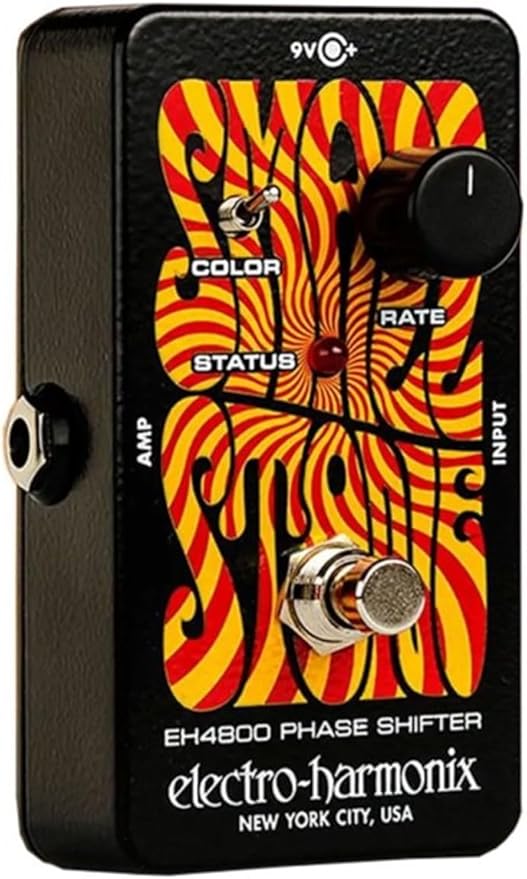
The classic Electro-Harmonix Small Stone Nano delivers vintage analog phaser tones. Compact design with iconic swirling phase sounds that defined psychedelic and rock guitar tones for decades.
View on Amazon
BOSS PH-3 Phase Shifter with versatile phaser modes and tap tempo. Features classic vintage phase sounds plus modern multi-stage phasing for creative modulation effects.
View on Amazon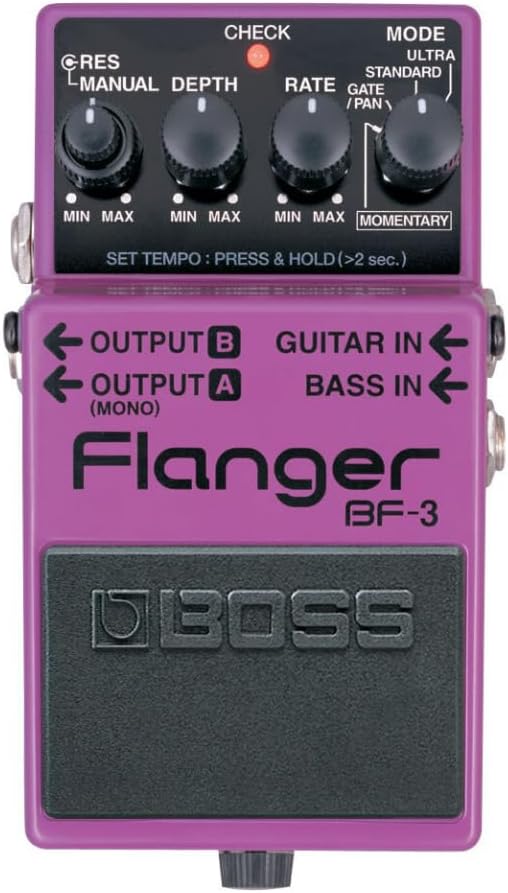
BOSS BF-3 Flanger with multiple flanger modes including Ultra and Gate/Pan. Delivers classic jet-plane swooshes and modern flanging effects with tap tempo control.
View on Amazon
The legendary BOSS CH-1 Super Chorus delivers rich, shimmering chorus tones. Features stereo outputs and versatile EQ control for everything from subtle shimmer to deep modulation.
View on AmazonOther modulation pedals include:
- Tremolo: Rhythmically changes volume using an oscillator (Boss TR-2, EarthQuaker Devices Hummingbird)
- Vibrato: Modulates pitch rather than volume for warbling effects
- Rotary speaker simulation: Recreates the spinning Leslie cabinet sound
Time-Based Effects: Delay and Reverb
Time-based effects process your signal by creating repetitions or ambient reflections. These pedals add space, depth, and dimension to your playing. Understanding reverb and delay fundamentals helps you use them musically rather than just as background wash.
Delay effects create distinct repetitions of your original signal, controlled by several key parameters. Delay time determines the gap between repetitions, measured in milliseconds. Feedback controls how many repetitions occur before fading out, while mix adjusts how loud the repeats are compared to your dry signal.
The evolution of delay technology tells an interesting story. Tape echo units like the Roland Space Echo and Maestro Echoplex dominated the 1970s with their warm, degrading repeats. These vintage machines added character through their mechanical imperfections.
Bucket-brigade analog delay pedals followed in the late 1970s and early 1980s. Analog delay typically offers warmer, darker repeats with natural signal degradation. Most analog delay pedals provide maximum delay time around 300-600 milliseconds, perfect for slapback and short rhythmic delays.
Digital delay arrived in the 1980s, offering pristine clarity and much longer potential delay times. A digital delay pedal can provide multiple delay modes, tap tempo functionality, and preset storage. Modern units bridge both worlds, offering analog-style warmth through digital processing.
Reverb creates the ambient reflection of sound as it bounces around a physical space. Different reverb types include:
- Spring reverb: Mechanical system creating classic surf and blues tones (developed by Hammond, popularized by Leo Fender in the 1963 Vibroverb)
- Plate reverb: Smooth, vintage studio sound from vibrating metal sheets
- Hall reverb: Simulates large concert venues with long decay times
- Room reverb: Creates smaller, more intimate spatial characteristics
The Boss RV-6 offers digital emulations of spring, hall, plate, modulated, gate, and room reverbs in a single pedal. This versatility makes it an excellent choice when you’re exploring different ambient textures.

The versatile BOSS RV-6 reverb pedal with eight reverb modes including shimmer and dynamic. Delivers studio-quality reverb tones from subtle room ambience to infinite atmospheric soundscapes.
View on AmazonFilter and Dynamic Effects: Wah, Compressor, EQ
Filter and dynamic effects shape your tone through frequency manipulation and volume control. These pedals often get overlooked by beginners but become increasingly valuable as your playing develops. They provide surgical precision for tone shaping that other effect categories cannot achieve.
Wah pedals sweep through a frequency range using a rocking foot controller, creating expressive vocal-like sounds. This filtering effect became synonymous with lead guitar expression and funk rhythm playing. Envelope filters automatically trigger similar sweeps based on your picking dynamics.
Compressor pedals manage your playing dynamics by reducing the difference between your loudest and quietest notes. This creates smoother, more consistent tone and adds sustain to your notes. While subtle, compression tightens your overall sound and helps you sit better in a band mix.
EQ pedals allow precise frequency adjustment across multiple bands. You can boost or cut specific frequencies to compensate for room acoustics, shape your tone for different songs, or sculpt your sound to complement other instruments. Think of EQ as a surgical tool for fine-tuning everything else in your signal chain.
These effects might seem less exciting than flashy modulation pedals or time-based effects, but they provide essential control over your fundamental tone. Many professional guitarists consider them non-negotiable for serious tone crafting.
Understanding these four effect categories helps you make informed decisions about which pedals serve your musical goals. Each family addresses specific sonic needs, and recognizing these purposes guides you toward building a thoughtful, versatile pedalboard.
The 4 Essential Effect Categories Every Guitarist Should Master
Understanding effect families helps you make informed pedal decisions. Each category serves specific musical purposes:
Distortion: Aggressive, compressed (RAT2, DS-1)
Fuzz: Extreme vintage clipping (Big Muff)
Boost: Clean gain increase (MXR Micro Amp)
Phaser: Swirling sweeps (Boss PH-3)
Flanger: Jet-engine swoosh (Boss BF-3)
Tremolo: Rhythmic volume pulses
Reverb: Room ambience (Boss RV-6)
Echo: Tape/analog warmth (vintage-style)
Always go LAST in signal chain!
Compressor: Even dynamics (MXR Dyna Comp)
EQ: Frequency sculpting (Boss GE-7)
Volume: Swells + balance (Ernie Ball VPJR)
- 1 TUNER – Receives cleanest signal for accurate tuning. Always first!
- 2 WAH / FILTER – Process guitar’s direct, unaffected tone for best response.
- 3 COMPRESSOR – Even out dynamics BEFORE gain stages for controlled tone.
- 4 GAIN PEDALS – Boost → Overdrive → Distortion → Fuzz (clean to dirty order).
- 5 MODULATION – Chorus, Flanger, Phaser, Tremolo (modulate shaped tone).
- 6 DELAY – Echoes that repeat your fully processed signal.
- 7 REVERB – Room ambience ALWAYS last for natural space!
How Many Pedals Do You Really Need as a Beginner?
There’s no magic number when it comes to deciding how many pedals belong on your first pedalboard. The right amount depends on the music you play, your budget, and your current skill level. Some guitarists create amazing tones with just two or three effects, while others build elaborate setups with a dozen or more.
The key is starting small and expanding thoughtfully as your musical needs grow. This approach saves you money and helps you truly understand each effect before adding more complexity to your pedal setup.
Choosing Based on the Type of Music You Play
Your musical style should guide your pedal choices more than anything else. Different genres require different sonic tools, and understanding this connection helps you build a focused collection rather than buying effects you’ll rarely use.
Blues guitarists typically need minimal gear to achieve their signature sound. A quality overdrive pedal, a delay for ambient solos, and perhaps a compressor cover most traditional blues tones. Many legendary blues players have built entire careers around one pedal and their amp’s natural breakup.
If you’re into rock and metal, your priorities shift toward gain-stacking options. You’ll benefit from both overdrive and distortion pedals to create layered textures and heavier crunch. A noise gate becomes important at higher gain levels, and a boost pedal helps your solos cut through during band practice.
Country players often favor crystal-clean tones with subtle enhancement. A compressor pedal smooths out your picking dynamics, while a touch of delay adds warmth without overwhelming your natural guitar voice. The best guitar tones in country music often come from restraint rather than complexity.
Funk and R&B guitarists love expressive, dynamic effects. An envelope filter or wah pedal becomes essential for those rhythmic, vocal-like tones. A compressor helps maintain consistency during intricate rhythm playing, keeping every note punchy and present in the mix.
Ambient and post-rock players typically need more elaborate pedalboards. Multiple delay and reverb options create layered soundscapes, while modulation effects like chorus and phaser add movement and texture. These genres often require five to eight pedals to achieve the signature atmospheric sounds.
Building a Small but Effective Starter Pedalboard
Most beginners should start with just three to five pedals maximum. This modest collection covers essential tonal needs without overwhelming you or emptying your wallet. A well-chosen small pedalboard teaches you how effects interact and helps you develop your ear for tone.
Your first pedalboard should include a tuner pedal as your foundation. This non-negotiable tool keeps you in tune during practice and performance. Add one gain pedal next—either an overdrive for blues and classic rock, or a distortion if you lean toward heavier styles.
The third essential spot goes to a time-based effect. A delay pedal offers incredible versatility, from subtle slapback echoes to ambient repeats. If you prefer space and atmosphere, a reverb pedal creates depth that makes your playing sound more professional and polished.

With these three core effects, you can create a surprising range of tones. One experienced player shared that after years of experimentation, they settled on just five pedals—a phaser, delay, two compressors, and an overdrive/tremolo combo. Interestingly, they noted playing mostly without effects except the compressor, proving that having multiple pedals doesn’t mean using them all simultaneously.
If budget allows, add a fourth pedal based on your specific needs. A compressor works beautifully for clean rhythm playing, while a boost pedal helps solos stand out. Consider buying used pedals from brands like Joyo, Donner, or NUX to save money while learning what sounds resonate with your style.
Your pedal setup should feel intuitive, not intimidating. Start minimal, master each effect individually, then experiment with combinations. This methodical approach builds genuine understanding rather than just accumulating gear.
When to Add More Pedals as Your Skills Grow
The right time to expand your pedal board comes when you encounter specific sounds you can’t achieve with your current gear. If you hear a tone in your head that your existing setup can’t produce, that’s your signal to research what type of effect creates that sound.
Avoid “GAS”—gear acquisition syndrome—which drives guitarists to buy many pedals based on social media hype rather than genuine musical need. One forum member described going down a “rabbit hole” after a pedals discussion, suddenly feeling they needed a Timmy overdrive, EQ pedal, reverb, and the “full gamut” of effects plus a proper power supply and board. This compulsive acquisition mindset distracts from actual playing and musical growth.
Instead, expand thoughtfully and purposefully. Add a modulation pedal when you want chorus or phaser textures in your sound. Invest in a looper pedal when you’re ready to practice over backing tracks you create yourself. Get a boost when your solos need more presence during live performances.
One guitarist wisely noted they only want pedals to “add more freedom and creativity without the pressures of conformity” rather than buying what’s considered cool. This mindset keeps your focus on musical expression instead of chasing trends or collecting gear for its own sake.
Remember that legendary guitarists have created iconic sounds with minimal equipment. Your pedals are tools that enhance your playing, not magic solutions that replace practice and technique. The space between your hands and your amplifier matters far more than having an elaborate pedal board filled with options you barely understand.
As your skills develop, you’ll naturally discover genuine needs that justify new additions. Trust this organic process rather than rushing to fill every spot on a large board. Quality always trumps quantity in both your playing and your gear choices.
Should You Start With a Multi-Effects Pedal or Individual Pedals?
The multi-effects versus individual pedals debate is something every beginner guitarist encounters early in their tone-searching adventure. Both approaches have real advantages, and neither choice is wrong. Your decision depends on your budget, learning style, and what you want to achieve with your sound.
Understanding the benefits and limitations of each option helps you invest wisely from the start. Let’s break down what each approach offers and when one makes more sense than the other.
The Advantages and Drawbacks of Each Approach
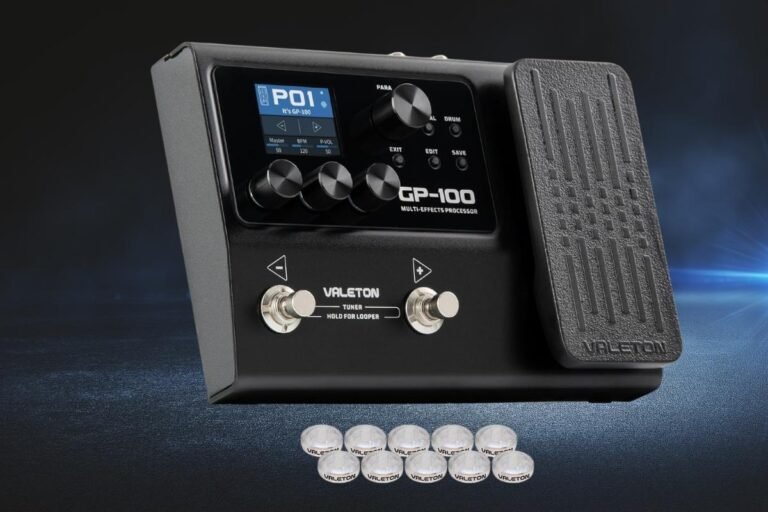
Multi-effects units pack dozens of effect emulations into a single device. They’re popular with beginners for good reasons, but they also have some trade-offs worth considering.
Multi-effects units offer several compelling benefits:
- More affordable than buying multiple individual pedals
- Compact footprint that saves pedalboard space
- Built-in tuners and amp modeling included
- Access to virtually every type of effect in one box
- Perfect for discovering which sounds inspire you
You can find units like the Zoom G1X used for around $35. That gives you access to chorus, phaser, flanger, multiple delay types, and various distortions without separate purchases.
However, multi-effects units have some downsides. The menu-diving and digital interfaces can feel overwhelming at first. The sound quality of individual effect emulations often doesn’t match dedicated pedals. Many guitarists find them less immediate and inspiring to use compared to physical stomps.
- Superior sound quality, especially for analog effects
- Intuitive one-pedal-one-function operation
- Satisfying physical experience of stomping switches
- Ability to create personalized signal chains
- Better resale value when upgrading
The drawbacks include higher total costs, more pedalboard real estate required, and the need for power supply solutions. You’ll also need patch cables to connect multiple guitar parts together, which adds complexity.
Discovering Effects Through All-in-One Devices
Multi-effects processors excel as learning tools for exploring different pedal types. Units like the Boss Katana include emulations of classic pedals such as the Blues Driver, Tube Screamer, and RAT.
This experimentation phase proves invaluable for understanding your preferences. You can try compressors, phasers, flangers, and various distortion flavors without buying each separately.
One smart approach shared by experienced players: if you’re transitioning from a modeling amp to a traditional tube amp with pedals, review the presets you used most on your modeler. Identify what effects they contained. This tells you exactly which physical pedals to prioritize.
For example, the Katana includes emulations of the Boss BD-2, OD-1, OD-2, two fuzz pedals, and more. If you constantly used the BD-2 emulation, that’s a clear signal to buy a real Blues Driver or similar overdrive pedal.
This discovery process helps you understand what sounds inspire your playing. You’ll learn which guitar pedals every serious player in your genre relies on.
Making the Transition to Individual Stomps
Many guitarists start with multi-effects for exploration, then gradually replace their most-used effects with dedicated pedals. This hybrid approach makes financial and practical sense.
Once you find yourself using the same three to five effects repeatedly, it’s time to invest in quality individual versions. You can keep your multi-effects unit for occasional sounds or as a backup device.
Some players noted that tube amps sound so much better than modelers that the focus should be on getting a great amp sound first. Then add only the essential pedals you genuinely need.
There’s no universal timeline for switching. Pay attention to your workflow and what frustrates you. If menu-diving breaks your creative flow, individual pedals might suit you better. If you love having endless options at your fingertips, a multi-effects unit could serve you well indefinitely.
Consider switching to individual pedals when:
- You consistently use the same few effects
- Sound quality becomes more important than variety
- You want faster, more intuitive control
- Your playing style has become more defined
Remember that there’s no wrong choice here. Some players thrive with multi-effects throughout their entire careers. Others prefer the focused simplicity and superior tone of individual stomps from day one.
Your best path forward depends on your budget, patience with technology, and musical goals. Both approaches get you making music, and that’s what matters most.
Pedal Order and Signal Flow for Beginners
Connecting your pedals in the right sequence unlocks their full potential and helps you avoid muddy or chaotic sounds. While the concept of signal chain might seem intimidating at first, understanding pedal order follows logical principles that make sense once you see how effects interact with each other. The good news is that you don’t need to memorize complicated rules.
There are proven conventions that work well for most musical situations. These guidelines give you a solid starting point that sounds clean and professional right out of the gate.
Basic Pedalboard Layout for Clean and Intuitive Use
The standard pedal order follows a specific path that processes your guitar signal in stages. Each effect builds on what came before it, creating a cumulative tone that shapes your overall sound. Here’s the conventional signal chain that works for most players:
- Tuner pedal – Receives the cleanest possible signal for accurate tuning
- Wah and filter effects – Process your guitar’s direct, unaffected tone
- Compressor – Evens out dynamics before gain stages
- Gain pedals – Boost, overdrive, distortion, and fuzz (lowest to highest gain)
- Modulation effects – Chorus, flanger, phaser, and tremolo
- Time-based effects – Delay first, then reverb last
This arrangement makes logical sense when you consider what each effect does. Your tuner goes first because it needs to hear your guitar’s pure tone without interference from other effects. Wah and filter pedals typically sound best when they’re shaping your guitar’s direct signal rather than processing effects that come after them.
The compressor comes early to smooth out your playing dynamics before you add distortion or overdrive. This creates a more controlled and consistent tone throughout your signal chain.
Gain Staging With Overdrive and Distortion
Understanding how gain pedals interact is crucial for getting great tones. When you stack multiple drive effects, their order dramatically changes how they sound together. Placing a boost before an overdrive pushes the overdrive harder, creating more saturation and sustain.
Running an overdrive into a distortion pedal adds complexity and character to the distortion’s voice. Many professional guitarists build their signature tones exactly this way, layering different gain stages to create rich, dimensional sounds.
The conventional approach arranges gain pedals from cleanest to dirtiest. A clean boost comes first, followed by overdrive, then distortion, and finally fuzz if you use one. This creates natural-sounding gain structures that respond well to your playing dynamics.
However, some players intentionally break these conventions for unique results. Placing a boost after your distortion increases volume and presence for solos without adding more saturation. Running fuzz before overdrive can create interesting textured tones that sound different from the standard arrangement.
When stacking drive pedals, subtle settings often work better than maxing everything out. Try setting your first overdrive with moderate gain and your second distortion with lower gain for a thick, harmonically rich tone that still retains clarity.
Where to Place Modulation Pedals and Time-Based Effects
Modulation effects typically go after your gain pedals because you usually want to modulate your already-shaped tone. Putting chorus after overdrive creates those beautiful shimmering driven sounds you hear in classic rock recordings. If you placed chorus before your overdrive, the overdrive would distort the modulated signal, which usually sounds less musical.
The same principle applies to other modulation effects like flanger, phaser, and tremolo. They sound best when they’re adding movement and texture to your complete tone rather than having their output heavily processed by gain stages.
Time-based effects like delay and reverb almost always go last in your signal chain. This placement allows them to add space and ambience to your fully processed tone. When delay and reverb come last, they create natural-sounding echoes and room reflections that enhance everything before them.
If your amplifier has an effects loop, consider using it for your delay and reverb pedals. The effects loop places these pedals after your amp’s preamp section but before the power amp. This setup often sounds better when you’re using high amp gain, preventing your delays and reverberations from becoming muddy or distorted.
Remember that these guidelines exist to help you achieve predictable, pleasing results quickly. But they’re not rigid commandments carved in stone. Start with the conventional pedal order to understand why it works, then feel free to experiment with variations.
Have fun trying different arrangements and trust your ears. Sometimes the “wrong” pedal order creates exactly the unique sound you’re looking for. The right decisions for your tone are yours and yours alone to make.
Tips for Choosing Your First Guitar Pedals
The secret to selecting the best guitar pedals isn’t following trends or copying your favorite players—it’s matching gear to your specific setup and style. Many beginners make expensive mistakes by purchasing pedals based on hype rather than actual needs. The tone of the guitar you’re trying to achieve should guide every decision, not what’s currently trending on social media or gear forums.

Making smart pedal purchases requires understanding three critical factors. First, you need to know how pedals interact with your existing equipment. Second, you must identify what sounds serve your musical goals. Third, you should consider practical aspects like portability and budget that affect long-term satisfaction.
Your Gear Foundation Matters More Than You Think
Your electric guitar and guitar amp form the foundation of your entire sound. Pedals should enhance this foundation, not fight against it. Understanding how your specific gear responds to effects will save you from purchasing pedals that don’t work well with your setup.
Pickup type dramatically affects how pedals respond to the sound of your guitar. Single-coil pickups found in Stratocasters and Telecasters have more clarity and brightness. They typically benefit from warmer overdrive pedals that add body without harshness. Humbuckers found in Les Pauls and SGs have more natural midrange and can handle higher gain pedals without becoming muddy.
Your guitar amp’s characteristics matter just as much. If you own a clean amp like a Fender Twin or Vox AC15, you’ll need overdrive and distortion pedals to create driven tones from scratch. These amps provide a blank canvas for your pedals to shine.
However, if you have a high-gain amp like a Marshall JCM800 or Mesa Boogie, you might only need boost pedals to push your amp’s natural distortion. Adding high-gain pedals to an already distorted amp can create muddy, indistinct tones. The sound of your guitar through your specific amp should guide your pedal choices—if your base tone is bright, choose warmer pedals; if it’s dark, select pedals that add clarity.
Always test pedals with your actual gear when possible. A pedal that sounds amazing through one amp might sound harsh or lifeless through another. Many music stores allow you to bring your guitar and test pedals through similar amps before purchasing.
Know Your Musical Identity Before Shopping
Understanding your playing style and musical goals is arguably the most important factor in choosing pedals. Too many electric guitar players buy pedals that look cool but don’t serve their actual music. Ask yourself these questions before making any purchase:
- What music do I play most often?
- What specific sounds do I hear in my head?
- What problems am I trying to solve?
- Which guitar heroes inspire my tone?
Different musical styles naturally suggest different pedal priorities. Blues and classic rock players typically prioritize quality overdrive pedals and maybe a delay for solos. Modern metal players need tight, high-gain distortion and possibly a noise gate to control feedback. Indie and alternative electric guitar players often gravitate toward chorus, tremolo, and ambient delays that create atmospheric textures.
Country guitarists frequently rely on compressors for that snappy, articulate attack and clean boosts to push solos forward. Jazz players might use only a subtle compressor and reverb, keeping their tone clean and dynamic. Your musical context should dictate your purchases, not marketing or peer pressure.
Here’s crucial advice that many beginners need to hear: don’t spend your savings on a Klon Centaur just because everyone on Instagram subconsciously suggests you should. Don’t buy a trendy boutique pedal that doesn’t match your actual musical needs. As one experienced player wisely noted, most of the time we want something we think we need to become better players when we just need reliable tools for the job.
Let go of what you think is cool. Eliminate doubt and confusion to allow more freedom and creativity without the pressures of conformity. The best guitar pedals for you are the ones that help you create the music you love, not the ones with the highest price tags or most Instagram likes.
Trust your ears and musical instincts over gear forums and influencers. If a $50 overdrive pedal gets you the tone you need, it’s infinitely better than a $300 boutique option that doesn’t serve your music.
Practical Considerations for Your Setup
Beyond tone, you need to consider practical factors like portability, the actual number of pedals you’ll use, and pedalboard size. These logistical details affect your playing experience more than you might expect.
Think about your performance context. If you’re gigging regularly and loading gear in and out of venues, a smaller, lighter pedalboard makes tremendous sense. You’ll appreciate the portability every time you carry your gear. If you’re primarily playing at home, a larger board is perfectly fine since it never leaves your practice space.
Start small and expand gradually. A compact board with three to five essential pedals is often more musical and manageable than a massive board with twenty options. Many experienced players eventually downsize to simpler setups after years of experimentation. One guitarist shared that their entire pedalboard consists of just five pedals that perfectly fit their needs—proof that more isn’t always better.
Once you have more than two or three pedals, you’ll need a dedicated power supply rather than individual batteries or adapters. Batteries die during performances, and wall adapters create cable clutter. A quality power supply keeps everything organized and reliable. The tone of the guitar can also suffer from inconsistent power, making this investment worthwhile.
Quality patch cables matter more than most beginners realize. Cheap cables create signal loss, noise, and reliability problems. Invest in decent patch cables from brands like EBS, Rockboard, or Mogami. Your guitar amp will receive a cleaner signal, and you’ll avoid frustrating technical issues during practice or performances.
Budget matters, especially when you’re starting out. Affordable brands like Joyo and NUX offer robust, inexpensive pedals perfect for experimentation. These pedals sound surprisingly good and let you explore different effect types without breaking the bank. You can always upgrade individual pedals later once you know exactly what you need.
Consider buying used pedals from reputable sources like Reverb or local music stores. This approach lets you try different options without major financial commitment. If you don’t like something, you can usually resell it for close to what you paid. This trial-and-error process is valuable for discovering your preferences.
Remember that pedalboard building is a journey, not a destination. Your needs will evolve as your skills and musical interests develop. Starting with a thoughtful, small collection that serves your current music is far better than accumulating dozens of pedals that mostly sit unused.
Genre-Specific Pedal Guide: Build YOUR Perfect Setup
Different musical styles need different tools. Match your pedals to YOUR music, not hype:
- ✓ Overdrive (Boss SD-1, TS9)
- ✓ Delay for solos (Boss DD-3T)
- ✓ Optional: Compressor (clean tones)
- ✓ Minimal setup = classic tone
- 💰 Budget: $150-250 total
- ✓ Distortion (RAT2, Boss DS-1)
- ✓ Overdrive for gain-stacking
- ✓ Noise Gate (high-gain control)
- ✓ Boost for solos (MXR Micro Amp)
- 💰 Budget: $200-350 total
- ✓ Compressor (snappy attack)
- ✓ Clean Boost for solos
- ✓ Subtle Delay (warmth)
- ✓ Focus: crystal-clean tones
- 💰 Budget: $150-300 total
- ✓ Wah or Envelope Filter (essential!)
- ✓ Compressor (consistency)
- ✓ Light Overdrive (touch of grit)
- ✓ Expressive, dynamic effects
- 💰 Budget: $200-350 total
- ✓ Multiple Delays (layered echoes)
- ✓ Reverb (spacious atmospheres)
- ✓ Modulation (chorus, phaser)
- ✓ Volume pedal (swells)
- 💰 Budget: $300-500+ (5-8 pedals)
- ✓ Chorus (shimmering textures)
- ✓ Tremolo (rhythmic pulses)
- ✓ Delay (ambient repeats)
- ✓ Light Overdrive (edge)
- 💰 Budget: $250-400 total
• Dozens of effects in one box
• Perfect for discovering your sound
• Compact, saves space
• Built-in tuner + amp models
• Lower sound quality than dedicated
• Less immediate, less inspiring
• Digital interface learning curve
• One pedal = one function (intuitive)
• Satisfying physical stomp feel
• Custom signal chains
• Better resale value
• Takes more pedalboard space
• Need power supply + patch cables
• Complexity grows with quantity
- Start with multi-effects for discovery. Zoom G1X ($35 used) lets you try everything. Replace favorites with individual pedals later.
- Buy used from Reverb/local shops. Save 40-60%! Boss pedals last forever. Test, resell if you don’t like it. Low risk!
- Budget brands ROCK for beginners! Joyo, Donner, NUX offer solid pedals $30-60. Perfect for experimentation without breaking bank.
- DON’T buy boutique first! That $300 Klon clone won’t make you better. Master a $50 SD-1 first. Upgrade when you understand WHY.
- Invest in power supply EARLY. Batteries die mid-performance. Wall adapters = cable mess. Quality power = reliable gigs ($50-100).
- Test with YOUR gear before buying! Pedals sound different through different amps. Bring your guitar to store. Avoid expensive mistakes!